

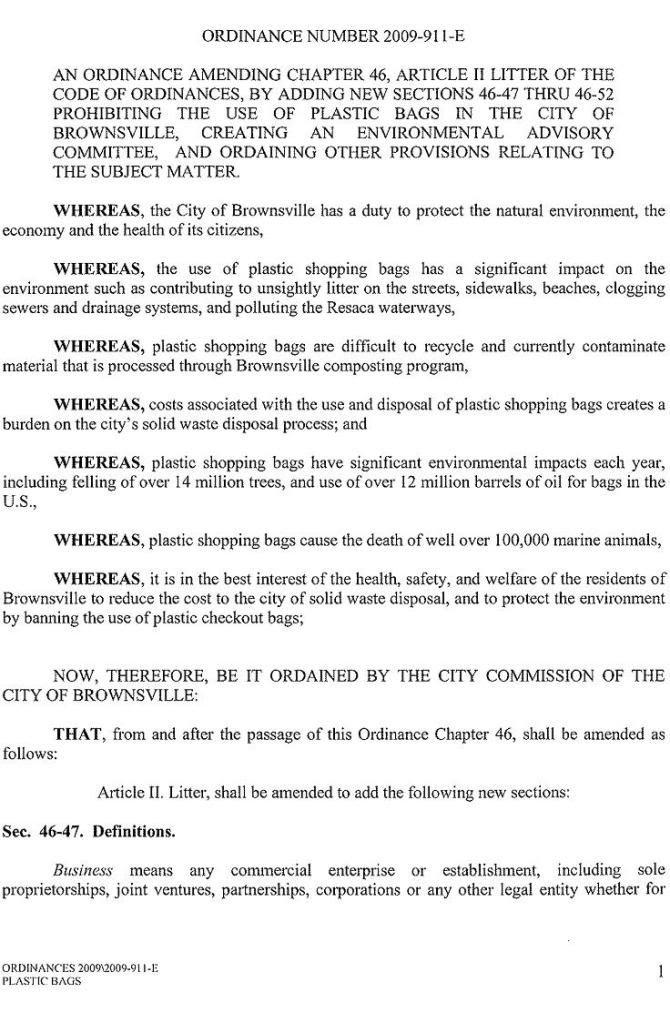
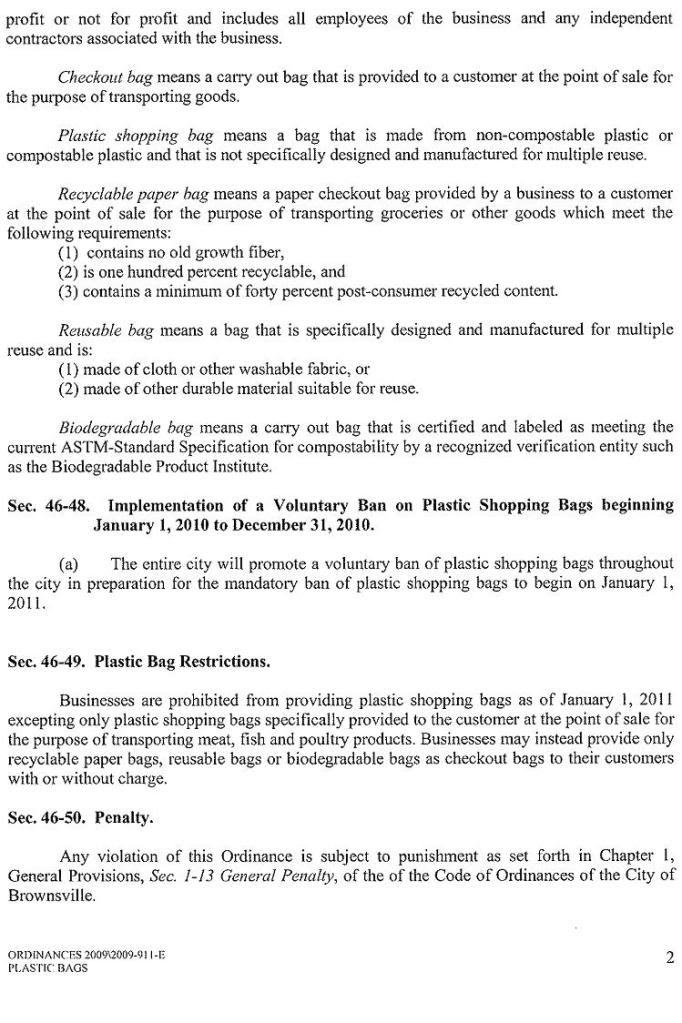
Brownsville, Texas has become the first city in the state of Texas to successfully pass a plastic bag ban ordinance. I will be the first to admit that I was blown away when I heard that they had actually pulled this off. It took them two years of hard work to do so and I would like to congratulate the City for their efforts!
The ordinance (below) sets up a one year voluntary compliance with a mandatory compliance to go into effect in 2011. It allows for the use of reusable cloth bags, approved biodegradable plastic bags and recyclable paper bags to be used in the place of the traditional plastic bags that we have become accustomed to. It also sets up an advisory committee to oversee the implementation and enforcement of the new ordinance.
After talking with local Lower Laguna Madre area officials in the City of South Padre Island and Port Isabel, it seems that they are very interested in moving forward on a similar law in order to protect our Laguna Madre, Gulf of Mexico and their beaches from the dangers and negative effects of what has been popularly called Texas' new tumbleweeds.
Tuesday, January 19, 2010
Brownsville, TX Bans The Bag!


Monday, January 18, 2010
Fab Bag Vid
With a shoutout to our friends over at the Plastic Pollution Coalition, I proudly snatch one of their recent posts to bring you a fab BYOBag video - here is their post:
"We are delighted to share with you this YouTube video, an awesome music clip featuring Tim Minchin. The message is as simple as it is important: bring your own canvas bags to the store!
Directed by Stephen Leslie, this video was originally recorded for BBC’s Comedy Shuffle. We’d like to thank our friend Sara Bayles, author of the popular blog The Daily Ocean for giving us the heads up."
Take time to check the Plastic Pollution Coalition website out - they got their heads screwed on juuuust right!
Friday, January 15, 2010
Aveda Caps Program Still Collecting!

This reminder from our Rhode Island correspondent, Kira Stillwell, whose daughter, Bryn, attends Narragansett Elementary School. They are throwing down a challenge to other schools to see who can collect the most voluminous heaps of plastic bottle caps.
The school sent the following message home with their students recently: "Imagine the impact on this recycling effort when thousands of schools across the country participate! This program educates students (and families) and underscores the importance of positive change, as well as our responsibility for taking care of our environment. It empowers us all to stimulate change on a local and national level. Beyond the benefits to environmental conservation, it teaches us that when we work together with a common purpose, we can effect change!"
Hot-diggety - therez finally some lernin' goin' on at them schools!!
AND, that message is resonating - so far they have three large bulging bags of caps in the school lobby, with the goal of filling the space with forty more. Getting this type of awareness tattoo'd into pre-teen synapses is of utmost importance, as it can build lifelong understanding and appreciation of the impact we have on the environment, inadvertently, just by our everyday use of otherwise-innocuous items like bottle caps.
Not all caps are candidates for this recycling program, so please take the time to visit the Aveda website to view the particulars and download goodies like nature-with-bottle-caps images suitable for coloring...AWRIGHT!
Bravo Bryn, Kira and NES!!!
Wednesday, January 13, 2010
CA Recylers Ripped Off by State

How can I report this in a positive tone? Let’s start with a description of California’s recycling program: every “recyclable” bottle and can is sold with a minimum five cent CRV (Calif Redemption Value) charge. That five cents goes into a fund intended, essentially, to repay those that return their used containers – easy enough to understand, yes?
Interestingly, a lot of Californians just never seek the CRV refunds, instead opting to throw the items away or “curbside” recycle them via local municipal pick-up. Bottom line, the program takes in muuuuch more $$$ than it doles out. [I like what you are thinking, “Use that $$$ to enhance the program!!!” – but stop a minute and try to think like a half-wit, thievin’, greaseball politician… :) OK, now read on.]
The state, now broke after a drunken-sailor spending spree decade, smells the sweet aroma of idle $$$ piling up and pretty-much steals from this fund to pay for costs of unrelated state activities that they apparently thought would somehow pay for themselves…ugh! Subsequently, our recycling programs are suffering, recycling centers are closing and the recycling effort’s future is atrophying.
Lots of lame-o excuses and half-baked, odd-ball ideas from the govvies on how to “save” this program are put forth in the article – none of which fully entail them putting the recycling $$$ back into the recycling program [sorry, that’s too simple]. As comedian Chris Rock may quip, “I guess it’s how they wuz rrraaAAaaiiised!”
OK, “positive tone” item: additional CRV fees are proposed to help cover the higher costs of recycling some fringe plastics – let’s hope the politicians don’t sneak this $$$ away for their retirement funds, gerrymandering costs or “new bridges to nowhere”.
Final smart-alec remark: Don’t Steal, the Government Hates Competition!
Thursday, January 7, 2010
Sign of the Times!

Well…let us all take credit for this one – we are changing society. I shot this photo outside of a single location of the “largest food retailer in Southern California” – this sign ain’t just posted outside the hippy-dippy organic coop (where I normally shop!). This is a big deal: you cant drive more than about five miles around this area without seeing one of their 400 locations – and they are telling their customers to remember their reusable bags – Chido, SWEEET & Bravazo!!
We are talking about a nice big shift in thinking at the retail level about the problem of single-use plastics. (I’ve protected the store’s name, so that the very un-neighborly American Chemistry Council doesn’t cause any trouble for them…and you know they would.)
It’s true that every time I go to the grocery store, I see more and more people bringing their reusable bags,. So (y)our message is sinking in…it’s just taking time… So keep on setting a fine example at restaurants, hardware stores, department stores and even thrift stores (though the latter is a great place to get reusable bags for CHEEP!) – places other than a grocery store that still dispense plastic bags.
Even my mom even remembers to take her bags out of the car when she shops, so times they are a-changin’ – NICE!
Monday, January 4, 2010
Focusing Attention on the Other Gyres

The 'Great Pacific Garbage Patch' has slowly gained much needed recognition, and that's a good thing, but what about the swirling garbage in the other 4 major Gyres? An energetic group of marine scientists are about to start investigating them with the 5 Gyres Project, the first global study of plastic marine pollution. A collaboration between three groups; The Algalita Marine Research Foundation (AMRF), Livable Legacy, and Pangaea Explorations; 5 Gyres will expand upon AMRF’s groundbreaking research on plastic pollution in the North Pacific Gyre, where wind and current patterns circulate untold billions of plastic particles. The 5 Gyres Project will begin to sail January 7th across the North Atlantic, and again in August across the South Atlantic Gyre, researching plastic. Surfrider’s Stiv Wilson, Chair of the Portland, Oregon Chapter and editor-in-chief of Wend Magazine will be on board of the first sail as part of the research team.
"Our plastic pollution is literally entering the food chain, getting into the food we eat and potentially exposing us to toxic chemicals” said actor/activist Ed Begley Jr., “we need to change our disposable habits now - we simply can’t afford to keep trashing our oceans.”
Through two research expeditions across the North and South Atlantic Gyres, 5 Gyres will gather international data on plastic pollution, collecting surface samples and foraging fish for evidence of plastic ingestion. Directing the research, funding, and communications for the project, husband-wife team Marcus Eriksen and Anna Cummins will manage both expeditions. Dr. Eriksen, AMRF’s Director of Project Development, and Cummins, co-founder of Livable Legacy, Inc., have traveled previously with Captain Moore across the North Pacific Gyre.
“We’ve now seen how bad things are in the North Pacific gyre, as plastic trash continues to wash off our coasts and out to sea,” stated Cummins. “We know very little however about plastic pollution in the four other large oceanic gyres. This is a chance to go global with the research and with our public communication campaigns.”
The crew will maintain a blog documenting the voyage at www.5gyres.org including videos and photographs of the research. Also on the 5gyres.org site is an overview of plastic marine pollution – ecosystem impacts, scientific literature, and land-based solutions
The first leg of the North Atlantic expedition will set sail on January 7th from the US Virgin Islands and will cross the Sargasso Sea, an area of relative calm between the West Indies and the Azores. The crew will stop in Bermuda, giving a series of public lectures with local NGOs, meeting with the American Ambassador to Bermuda, and picking up new crewmembers before sailing on to the Azores. The second expedition in August, 2010 will cross the South Atlantic Gyre, from Rio de Janeiro, Brazil to Cape Town, South Africa. To date, little research on plastic pollution has been conducted in the Southern Hemisphere.
“Our research goals are to understand the endgame for plastic pollution at sea by sampling the ocean surface, seafloor, and the contents of fish stomachs.” Said Dr. Marcus Eriksen.
San Francisco based Blue Turtle is the project’s title sponsor, with key additional sponsorship provided by Ecousable, Quiksilver Foundation, Patagonia, Keen Footwear, Surfrider Foundation, and Aquapac.
The crew will follow the two Atlantic gyre voyages with a yearlong public communications project titled “The Last Straw”. Eriksen and Cummins will embark on a 2000-mile North America East Coast cycling/speaking tour to lecture about the Atlantic plastic soup, and will build a boat from a quarter-million plastic straws in Paris, France. The boat, to be called “STRA,” will sail the Seine River and cross the English Channel. “Like the JUNKraft that sailed across the Pacific Ocean on 15,000 plastic bottles,” explained Eriksen, “STRA will also bring attention to the environmental hazards of plastic pollution and begin the important conversation about solutions.”
Check back regularly for their reports here.....
Go crew!!
Wednesday, December 30, 2009
Bottled water: The New Vice
 Great ideas popping up from Michigan – tax the lazy, and give to the undereducated! Good to see bottled water join its brethren, Gambling, Alcohol and the Adult Industry (the other vices), as a taxable vice that can help under-served (no pun) sectors of society. The Wolverine State says “tax bottled water and put that money toward education” – read about it here.
The interesting twist here is that they propose to put an end to the state's groundwater being extracted (and bottled) without what many see as proper compensation to the state's residents. So perhaps instead of "Tax the Lazy (bottled water users)" and give to the undereducated, we can think of it as a Robin Hood-esque drama: Tax water rustlers and give to the undereducated...and hopefully clip plastic bottle production? Revolutionary…
A similar and hard-hitting position is taken by two recent movies on the subject of groundwater ownership: Flow and Tapped - check them out and make the connection to the basics of the Rise Above Plastics campaign for yourself!
HAPPY NEW YEAR!
Sunday, December 20, 2009
Cross-border Plastics - 1440 Bottles/day, Two Lightbulbs

In San Diego, we are (still) battling an ancient and ongoing problem which is unique to our local geography and regional political boundaries: sewage and trash washes across the border from Mexico into the US in San Diego County when the rains eventually come to sunny California & Baja. The Mexican city across the border, Tijuana, is largely unable to stop the flow, for many reasons, the main one being that the riverbed’s uphill watershed sits mainly on the Mexican side, with the sea-level riverbed finishing it’s flow to the ocean on the US side. That’s the simple explanation – believe me that it’s waaaaay/mucho more involved than that, but for our Rise Above Plastics concerns that’s all we need to know for now. (Surfrider’s Dan Murphy and the Tijuana river Citizen’s Council and others have even formed a coalition, cleverly named “NO B.S.” [the B.S. part mainly means “Border Sewage] to try to fix the problem – wish us luck! Check out the NO B.S. blog. Lotsa good photos 'n stuff there.)
What’s this got to do with plastics? Well, the Tijuana River valley empties into the ocean, which means that the trash (lotsa plastic and tires)…empties…into…the…ocean. The photos in a recent Voice of San Diego story show the extent of the trash problem – repeated smaller storms lay down layers of trash and sand, and larger storms that come along wash that stratified trash out the estuary and into the sea.
To see for myself, I made the 20 minute ride down there on a rainy day last year (bad one – horses died in the flooding that day). I was a tad underwhelmed to see only about one-plastic-bottle-per-minute float by, along with the trees, etc being flushed out in the chocolate-colored water. ONLY ONE PER MINUTE?? But, do the math grasshoppah – that’s 60 minutes per hour times 24 hours to a day = 1440 bottles added to the oceanic trash heap in that day alone – yikes! My little brain then tried to imagine how many semi-Third World rivers dump into the ocean around the globe – in areas muuuch more rainy than So Cal – double yikes! (Light bulb above the head) We have a major problem here…!
It’s surprising that we were ever surprised that the Pacific’s “floating trash heap” even existed – (light-bulb above head, again - DING!) OF COURSE, where else would all that stuff go off to? We/I/old-conventional-“thinking” always just figured that it went “away” – out of sight, out of mind, y’know?
At least we now know where “away” is =====> our silent oceans.
Sunday, December 13, 2009
Beans for Bags in Rio!

Subtitle: Rio De Janiero Takes a Strong Stance Against Plastic Bags!
Great ideas from Brazil - a beans & rice CRV for plastic bags, read on:
From our Rio-via-San-Francisco Surfrider RAP rep, Melissa Legget:
Bags, Now Only of Reusable Material
RIO-
The government bill mandating that plastic bags distributed by stores be substituted for reusable bags was approved on June 24, 2009 by the Legislative Assembly of Rio de Janeiro (Alerj). The bill, proposed in 2007, took almost two years to be voted on because of pressure by various economic groups. Finally, the bill has finally been signed by Governor Sergio Cabral, making the legislation into law.
In those two years, sixteen parliamentary amendments were incorporated into the original government bill. An original amendment stated that stores continuing to use plastic bags would have to buy back each bag for R$.03 (US$.015) or give a kilo of rice or beans for every 50 bags returned to the store, even if that particular store did not distribute the particular bags in the first place. In the latest version of the law, stores are no longer required to buy back bags but will have to give at least a R$.03 discount for every 5 items to clients who choose to use their own bags. In the final text, the food exchange program was maintained.
Stores will also have to put up signs informing customers that plastic material takes more than one hundred years to decompose. Fines for not complying with the new law could reach more than R$10,000 (US$5,000). Large companies will have one year and small companies will have three years to implement the new legislation. The president of Alerj, Jorge Picciani (PMDB), affirmed that he will meet with business entities and write a new bill incorporating proposed alterations to the bill approved yesterday.
The bill was proposed in 2007 by the then State Secretary of the Environment, Carlos Minc, today Brazil's Minister of the Environment. The government's justification for the bill is that plastic bags cause grave problems for the environment, principally to streams and rivers, where the accumulation of this material provokes floods in regions close to rivers. Pressure by commercial entities and the plastic industry delayed the voting process.
BRAVO!
Saturday, December 12, 2009
Worth a Replay - The Work Of Felipe Bascope (ala Saatchi & Saatchi)!

[click on any image for a hi-def look...]
This last one is actual beach clean-up trash chicken-wired onto a billboard - click it for a closer look - it's eye-popping! (Dont be surprised if you see only plastics.)
Felipe put these into play in his days at the generous & mod media/marketing firm Saatchi & Saatchi. See more of Felipe's work on his blog!


 Posts
Posts


